
Beyond the Shame: why we need to reimagine sexual education for the next generation
Content flag: This article contains mention of sexual assault and victim blaming. Please take care of yourself as you read. You can access a list of supports at www.ontario.ca/page/connect-supports-survivors-violence#section-0
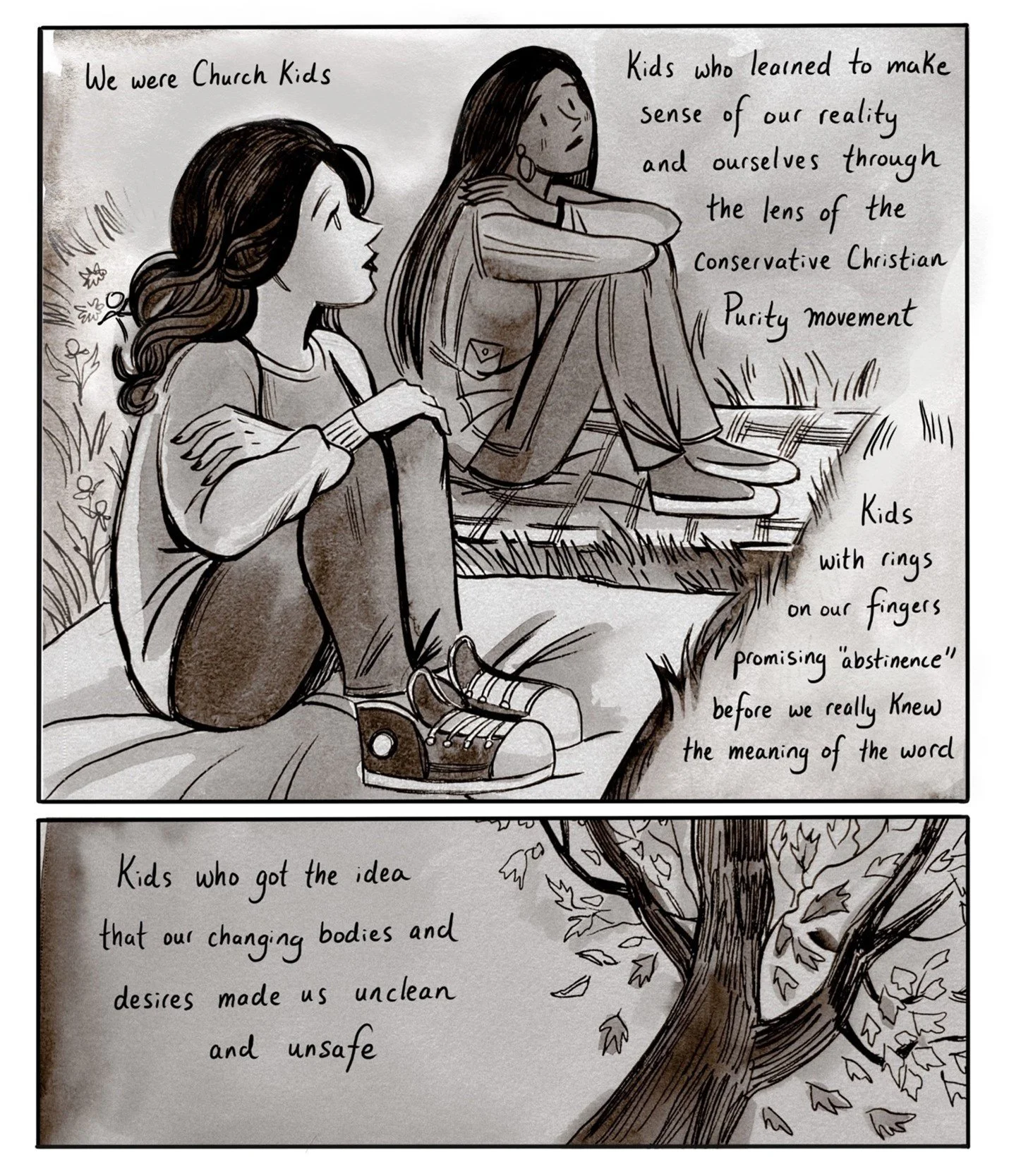
Stephanie Stalvey is a graphic artist who details her experiences growing up in Evangelical Purity Culture. This is a page posted on social media from her book, Everything in Color, available for preorder now.
For many of us, our sex education (if we had any at all) focused on avoiding STI’s and pregnancy, leaving out important information about relationships, gender, sexual orientation, pleasure, and navigating the complexities of our actual experiences. For some of us, the only message we got was “Don’t have sex until you’re married.” This is a core message of purity culture: sex is for married heterosexual couples and abstinence is for everyone else.
Purity culture is often presented as a loving framework to guide, protect and preserve something special - but the lived reality? For many of us, it was filled with so much shame and guilt. While abstinence is a valid and healthy choice for many people, the rigid regulations and unattainable expectations of purity culture infuse our understanding of our sexual selves with an immense amount of shame. In addition, the lack of information about sexual health, anatomy, and the absence of tools for negotiating consent and pleasure leave people unprepared for the challenges of real life. Even worse, purity culture teachings leave people - particularly girls and women - more vulnerable to sexual abuse and assault (Owens et. al, 2020).
If you grew up steeped in this ideology, you probably found that the promises it made didn’t hold up to real life, and many people are deeply harmed regardless of intentions behind the teachings. As an adult, as someone with children and young people in your life yourself, you may be wondering how do you support children to understand healthy sexuality, boundaries, and respect without the crippling baggage of guilt and judgement? How do we build a different path forward for ourselves and the next generation?
If you’ve ever asked yourself these questions, this post is for you; the first step is to better understand where we came from.
The Purity Promise vs the Patriarchal Reality
The strict regulations of purity culture are typically presented as traditional biblical sexual ethics and as the only path to a healthy, fulfilling sex life. However, on closer examination, these traditions are not nearly so consistent throughout the history of Christianity, and what is termed the 'biblical sexual ethics' of abstinence until a monogamous, heterosexual marriage is complicated by the actual narratives we find in the bible. While the bible does emphasize fidelity and justice within relationships, the shame-based requirements that we endured - rigid dress codes, the obsession with virginity as a “sacred gift”, and the condemnation of all sexual curiosity - are simply patriarchal concepts designed to control women and reinforce strict gender roles, starting in childhood.
This rigid “all-or-nothing” approach to sexuality actually leads to negative consequences like guilt, shame, and even more sexual promiscuity compared to non-religious counterparts (Coleman et al., 2022). This shame does not magically end on the wedding night either. The idea that virginity is a “gift” that guarantees a perfect sex life in marriage sets couples up for unrealistic expectations. Many women report that the ingrained feelings of shame and anxiety linger long after they are married, making it difficult to embrace intimacy fully and even resulting in higher rates of sexual pain than women who did not believe the teachings (Sawatsky et. al, 2024).
The idea that virginity is a “gift” that guarantees a perfect sex life in marriage sets couples up for unrealistic expectations.
This shame is not confined to women; it twisted the experience for young men as well. Boys were rarely taught that their own bodies or desires were shameful; instead, their natural sexual desire was labeled as powerful, out of control lust that needed constant monitoring. They were told they had to keep this part of them locked in, even being taught to “bounce their eyes” away from girls and women they find attractive, rather than being taught to see them as full human and not sexual objects. The autonomy of men is diminished by the belief that they cannot control themselves, while also getting a sense of entitlement where women’s virginity is viewed as a trophy they were responsible for securing.
In addition, purity culture teaching erases the validity of and demonizes anyone who experience attraction outside of the heterosexual binary (attracted to people other than just the opposite sex) or anyone who experiences gender in ways that don’t match the body parts they were born with. Trans and gender non-conforming individuals are not considered valid and valuable within these systems, and are often subjected to bullying, rejection, harmful conversion therapy, and experience disproportionate rates of sexual assault, homelessness, and suicide (Rhoades et. al, 2018).
Instead of teaching healthy connection and mature, responsible engagement with our own sexuality and that of others, this teaching offers only a rigid system of rules - rules that most people are unable to follow.
__________________________________________________________________________
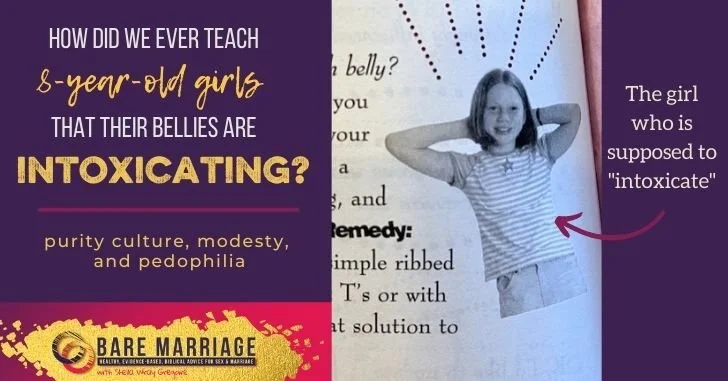
Purity culture teachings sexualize children
This graphic is from a blog by Sheila Wray Gregoire, a Christian author and educator who has researched the impacts of purity culture. The graphic references a photo and teaching from Dannah Gresh’s Secret Keeper Girl, a popular curriculum from the early 2000’s. In it, Dannah says that girls need to wear modest clothing because their bellies are ‘intoxicating’ to men: this sexualizes the bodies of children and re-inforces rape myths that blame girls and women for their rapes. You can read the full blog linked above to learn more about these harmful teachings from a Christian perspective.
__________________________________________________________________________
The Clothes We Wore: Double Standards that Harm Women
Purity culture’s rigid emphasis on heteronormative gender roles disproportionately burdens girls and women with the responsibility of being the ‘sexual gatekeeper’ - preserving not only their own purity, but that of men and boys as well. Even young girls are told that their clothing and body language has to be carefully managed to avoid “causing a brother in Christ to stumble into lust.” One of the authors remembers this vividly from her time at a Christian boarding school: girls had pages of dress code rules - fingertip length in dresses or skirts, no cleavage, no tight clothes, three fingers wide straps - while the boys essentially had to wear a shirt. There was so much shame around the process of getting dressed every single day. If your outfit drew any attention, the whisper was that you were being careless, even slutty. If a male struggled with the temptation, the burden was immediately placed on the girl to adjust her wardrobe, her posture, or her presence.
There was so much shame around the process of getting dressed every single day.
This narrative is deeply damaging. It places the entire responsibility for male sexual feelings - and even actions - onto women; outwardly shaming women and girls for simply having a body and reinforcing that we are sexual only when we are objects of someone else's lust, not as our own beings. It solidifies a crippling sexual double standard where men are excused as “struggling” while women are condemned as “temptresses.”
“Several key authors have contended that purity teachings characterize young men as inherently sexual beings without control over their urges or responsibility for uncontrollable sexual actions and situate young women as both gatekeepers of sex without any urges or sexuality of their own while simultaneously shaming young women as temptresses (Fahs, 2010; Ortiz, 2019; Owens et al., 2020)” (Nataranjan, 2022).
These teachings contribute directly to victim-blaming and rape culture. The horrific argument often presented is that a man’s sexual assault was him losing a fight against his desires, and a women’s failure was that she wasn’t a strong enough sexual gatekeeper.
So, How Do We Break the Cycle?
If you are a parent that grew up in this culture, you may be asking: How do I protect my child from potential harm without using shame and fear?
1 - Self reflection
The first step is to examine your own beliefs and ideas. Where did they come from? Are they based in fact or did they come from beliefs rooted in fear and shame? If you are still a person of faith, what interpretation of scriptures were you taught, and are there perhaps other ways to understand them? What are your values and how can you integrate those values to build a healthy sexual ethic to pass on to your kids?
When an individual can accept and integrate their sexuality as part of their identity while maintaining consistency with their personal beliefs, a healthy embodiment of sexuality becomes possible. Shifting from a fear-based, shame-driven model to one rooted in factual information helps give us access to trust and open communication, first for ourselves, and then for others.
2 - Prioritize honest sexual health education
Embrace your role as your child’s primary, most trusted source of sexual health information and resource yourself with age-appropriate, factual education (see previous blog posts for resources). Your child will inevitably find information from external sources like peers, social media and the internet, probably younger than you think. Start early and make sure you have the information and knowledge you need and letting them know that you aren’t afraid of their questions; this ensures that they can come to you and trust you to support them if they encounter uncomfortable or dangerous situations - or even if they are just curious.
3 - Teach the benefits of waiting - without the fear
Research shows that delaying initiation of sexual activity in adolescence has better outcomes, as long as it’s presented with agency and choices to say ‘yes’ or ‘no’ to sex (Imburgia et al, 2024). Instead of a shame and fear based approach focusing on all the reasons NOT to have sex, focus on genuine, positive outcomes for choosing to wait:
Allows time to become mature, building decision-making and emotional and relational skills
Increases the likelihood of more meaningful, intentional sexual encounters
Decreases the chance of unplanned pregnancy until they are financially, mentally, and physically ready
Decreases the chances of contracting an STI
4 - Shift from an “All or Nothing” to Harm Reduction
When young people are taught only the “don’t have sex until marriage” message, it may (or may not) delay their first sexual activity by a short amount of time, but it also means they’re less likely to take precautions when they do (Schalet, 2004). Driving cars carries risk too, but we don’t tell them not to drive; we teach them how to drive safely. The same goes for sex:
Teach them about barrier methods and contraception (everyone - not just girls!)
Teach them about the importance of regular sexual health screening
Teach them the vital importance of consent and clear communication with their partners
Don’t be afraid to talk about pleasure! This doesn’t mean we’re encouraging young people to to have sex - on the contrary, prioritizing what feels good can actually help them say no to sex they DON’T want.
Let them experiment with relationships - they need to learn how to love, communicate and set boundaries romantically long before sex enters the picture.
Shifting from a fear-based, shame-driven model to one rooted in factual information helps give us access to trust and open communication, first for ourselves, and then for others.
On a personal note from the authors, our teenage selves would have loved to have a parent who provided comprehensive information, open conversation, and support of our choices. That is something we can give to our kids.
Resources
Sheila Wray Gregoire: A Christian source for marriage and sex advice as well as an exploration of the harms of Evangelical Christian purity culture teachings. Her book The Great Sex Rescue (co-written with her team) is a great resource for Christians looking to build a different sexual ethic, and for ex-evangelicals looking to understand the impact of the teachings they grew up with. You can also find her on Instagram.
Linda Kay Klein is a writer, researcher, coach, and author exploring the impacts of purity culture. Her book Pure: Inside the Evangelical Movement that Shamed a Generation of Young Women and How I Broke Free is a great resource for people looking to understand and heal (or help others to heal) from the impacts of purity culture.
Stephanie Stalvey is a painter, writer, and comic book artist who details her experiences growing up in Evangelical purity culture. You can pre-order her book, Everything in Color now! You can also find her on Instagram.
References
Coleman, E., Jennings, T., Gleason, N., Danielson, S., Nielsen, K. H., Miner, M. H., & Rahm-Knigge, R. L. (2022). The Relationship between Compulsive Sexual Behavior, Religiosity, and Moral Disapproval. Journal of Sex & Marital Therapy, 49(3), 314–330. https://doi.org/10.1080/0092623x.2022.2117746
Christianson, M., & Eriksson, C. (2025). Virginity Control and Hymen (re)Construction: Gender Analysis from the Perspective of Young Women. Archives of Sexual Behavior. https://doi.org/10.1007/s10508-025-03272-6
Imburgia, T. M., Hensel, D. J., Hunt, A., James, R., Zhang, J., Cote, M. L., & Ott, M. A. (2024). Factors associated with early sexual onset and delaying sex in rural middle school youth. The Journal of Rural Health, 41(2), e12889. https://doi.org/10.1111/jrh.12889
Muskrat, T. Y., Porcaro, A. K., Worley, M. G., Franco, A. E., Parmenter, J. G., & Sánchez, F. J. (2025). “Being Yourself is a Sin”: The Impact of Evangelical Purity Culture on Sexual and Gender Minority People Socialized as Women. The Counseling Psychologist, 53(5), Article 00110000251352578. https://doi.org/10.1177/00110000251352578
Natarajan, M., Wilkins-Yel, K. G., Sista, A., Anantharaman, A., & Seils, N. (2022). Decolonizing purity culture: gendered racism and white idealization in Evangelical Christianity. Psychology of Women Quarterly, 46(3), 316–336. https://doi.org/10.1177/03616843221091116
Ortiz, A. M., Sunu, B. C., Wang, D. C. (2023) Purity Culture: Measurement and Relationship to Domestic Violence Myth Acceptance. Journal of Psychology and Theology. V51(4). https://doi.org/10.1177/0091647123118273
Owens, B. C., Hall, M. E. L., & Anderson, T. L. (2020). The Relationship between Purity Culture and Rape Myth Acceptance. Journal of Psychology and Theology, 49(4), 405–418. https://doi.org/10.1177/0091647120974992
Rhoades, H., Rusow, J. A., Bond, D., Lanteigne, A., Fulginiti, A., & Goldbach, J. T. (2018). Homelessness, mental health and suicidality among LGBTQ youth accessing crisis services. Child Psychiatry & Human Development, 49(4), 643–651. https://doi.org/10.1007/s10578-018-0780-1
Sawatsky, J., Lindenbach, R., Gregoire, S. W., & Gregoire, K. (2024). Sanctified sexism: effects of purity culture tropes on white Christian women’s marital and sexual satisfaction and experience of sexual pain. Sociology of Religion. https://doi.org/10.1093/socrel/srae031
Schalet, A. (2004). Must We Fear Adolescent Sexuality? Medscape General Medicine, 6(4), 44. https://pmc.ncbi.nlm.nih.gov/articles/PMC1480590/
