
Early & Open: conversations we actually need to have with kids
Lots of parents share the same goal: the desire to raise kids who are confident, safe, and know they can talk to them about anything. However, when the topic turns to sexual health, lots of parents tend to dread the famous “Talk.” You know the one - it’s super awkward, usually delayed, and almost always guarantees some anxiety for both parent and kid.
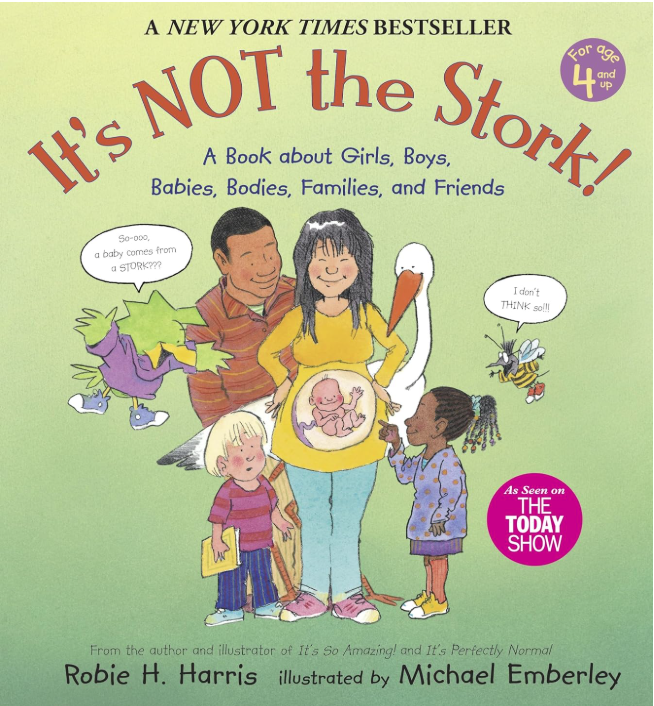
Cover image for the book “It’s NOT the Stork” by Robie H. Harris. The subtitle is “A book about Girls, Boys, Babies, Families, and Friends”.
The thing is, by treating sex as a scary, uncomfortable topic, we subconsciously send the signal that anything to do with sexual health is shameful or secretive. Research shows that early, open communication about sex is linked to better sexual health, abuse prevention, and more positive relationships for younger adults. Talking about things like boundaries, consent, and bodies in casual conversations helps give children facts while also building a solid foundation of trust.
Now, how do we replace this dreaded single, awkward lecture you ask? Here are three simple shifts you can make to start a lifetime of casually informed conversation, and to help you raise a child who has the information they need and can trust you to answer hard questions with empathy and honesty - even if the answer is “I don’t know, lets find out together!”
Tip #1 - Name The Body Part For What It Is
The way we talk to kids about their bodies - specifically their genitals - often is where the earliest seeds of shame are planted. It is incredibly common for families to swap out the correct terms, like penis and vagina, for a cutesy nickname. Why do we do this? We don’t give special names to our elbows or knees! Many parents feel they’re protecting their child’s innocence, but when we treat a body part as taboo we send a subtle but powerful message that it's shameful, embarrassing, or something we don’t talk about. This early conditioning makes it incredibly difficult for a child to speak up later about questions they might have, discomfort they may feel or even inappropriate touch involving those private parts. This is why organizations like the American Academy of Pediatrics have endorsed teaching children the correct anatomical names to enhance body image, confidence and openness. When we normalize the language, we chip away at the secrecy and shame that sexual abusers rely on.
Research shows that early, open communication about sex is linked to better sexual health, abuse prevention, and more positive relationships for younger adults.
Tip #2 - Don’t wait for “The Talk” - Start Early On and Keep the Door Open
A common mistake of the traditional approach to talking about sex is waiting for that single, terrifying, awkwardly anticipated conversation known as “The Talk.” This familiar custom turns sexual health into a monumental, often one-time event that generates anxiety for everyone involved.
We need to flip the script entirely. The goal should be to normalize starting these conversations early and talking often - we don’t have to wait! You can begin weaving accurate, age-appropriate facts into your everyday life when children are toddlers. Think of it as layering the information, just as you would with literally every other topic you teach them. When your four-year-old asks “why don’t they have a penis like me?” or “where does pee come from?”, this is your perfect low-pressure moment to teach a fact.
The positive effect on this is huge; by establishing yourself as a trusted source of information early on you ensure your children get facts instead of fear. This habit of open, lifelong dialogue is supported by major health research: A 2023 study found that adolescents who reported high levels of parental warmth and communication went on to having significantly better general health, mental health and sexual health outcomes as young adults (Ford et. al, 2023). This included lower rates of substance use and unintended pregnancy. It’s not just about giving them knowledge - it is building trust that allows them to come to trusted adults with the big and small challenges later in life.
Tip #3 - “But what if they ask…?”: Handling Tough Questions and Awkward Moments
Hesitancy with bringing up sexual topics is often because we’re avoiding those questions that we may not know the answer to, or because of our own discomfort.
It is natural to feel pressure and even overwhelm when your child asks a tough question. Our instincts might be launch into a full biology lesson, share a personal story, or avoid the question altogether - but lets try and resist that urge. Children are masters of asking simple questions, and it’s better to stick with simple answers If your six-year-old asks, “Where do babies come from?” they are not looking for a detailed description of intercourse and contraception. You can simply say: “Babies grow inside their mommy’s tummy, in a special part called the uterus.” Often, they’ll be happy with the answer and move on to the next activity.
Here are some more scenarios to think about:
Scenario 1: Six-year-old
Question: “how does the baby come out?”
Response to avoid: “Well, first the sperm meets the egg…” - this is too much!
Effective response: “The baby grows inside a special part in mommy’s belly called the uterus. When they’re ready to come out, the doctor helps the baby come out of the opening between mommy’s legs. Does that make sense?”
It’s also ok to divert the question to a more appropriate time - if your 6 year old asks an awkward question in a car full of people; just let them know it’s a really important question, and you want to take time to give them a good answer at home when you’re not driving! This is a great trick to use if you need some time to organize your thoughts and feelings about a tough or uncomfortable question. The important thing is that you come back to it.
Scenario 2: The Tween

A brightly colored cover image for the book “Sex is a Funny Word” by Corey Silverberg and Fiona Smyth. It features a drawing of four smiling young people with different color skin, one with glasses, and one who uses a mobility device.
Question: “Is it normal that there is hair around my private parts?”
Responses to avoid: Anything that dismisses or indicates that the topic is uncomfortable.
Effective response: “It’s totally normal to notice hair starting to grow around your private parts. It’s a sign of your body starting something called puberty; there will be other changes that happen as you grow. I’m glad you asked - do you have any other questions about puberty or anything else you’d like to talk about?”
This is also a great time to offer a book or website that your young person can explore on their own so that they don’t need to ask things that might feel awkward. Having another trusted family member or adult outside of their parents can also help with embarrassment for some young people.
By providing clear, straightforward information, you prevent confusion and anxiety. It keeps the conversation casual, which is key to making it ongoing. Don’t stress if it doesn’t come easy at first: you don’t need to know all the answers! It’s ok to say “I don’t know - but I’m going to find out and we can chat about that at bedtime (or whatever time you feel is most comfortable).” You can also go to your favorite sexual health educator website or book (see below) and find the answer together - that way you’re modeling not only that it’s ok to say “I don’t know” but you’re showing them safe and reliable sources of information that they can use themselves.
By answering clearly and calmly without making it a huge event, your child learns that asking you questions is a quick, reliable, and non-awkward way to get information. You are letting your child’s curiosity drive the pace, and as they get older their questions will naturally become more complex; and your answers will expand to meet that complexity.
It’s not just about giving them knowledge - it is building trust that allows them to come to trusted adults with the big and small challenges later in life.
____________________________________
Featured book covers:
“Sex is a Funny Word” by Corey Silverberg and Fiona Smyth (ages 8-10)
“It’s NOT the Stork” by Robie H. Harris (ages 4 and up)
Resources
Here are some great websites for you and your family to use: you can have a look first, but they’re safe places to let your kids explore on their own when you feel they’re ready.
Amaze.org: short, child-friendly videos about bodies, boundaries, safety, and growing up
Every Body Curious: “Every Body Curious is an entertaining and educational YouTube series about sexuality and healthy relationships for youth, ages 9-12.”
Teen Health Source: Sexual health information by teens, for teens
Other websites for parents and families:
Sex Positive Families: Offers inclusive, shame-free resources for families to talk openly about bodies, consent, and sexuality.
Talk More: “tools for families to have conversations about sexuality with kids early, often, and in shame-free ways.”
____________________________________
References
Ford, C. A., Pool, A. C., Kahn, N. F., Jaccard, J., & Halpern, C. T. (2023). Associations Between Mother-Adolescent and Father-Adolescent Relationships and Young Adult Health. JAMA Network Open, 6(3), e233944. https://doi.org/10.1001/jamanetworkopen.2023.3944
Sexual Behaviors in Young Children: What’s Normal, What’s Not? (2023, April 17). HealthyChildren.Org. https://www.healthychildren.org/English/ages-stages/preschool/Pages/Sexual-Behaviors-Young-Children.aspx
